
Smart IoT Pet Feeder
A modern, 3D-printed automatic pet feeder designed for remote feeding via smartphone. Built using Wi-Fi-enabled microcontrollers and efficient 3D-printed parts, this feeder dispenses food on a customizable schedule or on demand using a mobile app.
Update: I am actively updating this project page with improved documentation, refined portion calibration, and additional reliability testing.
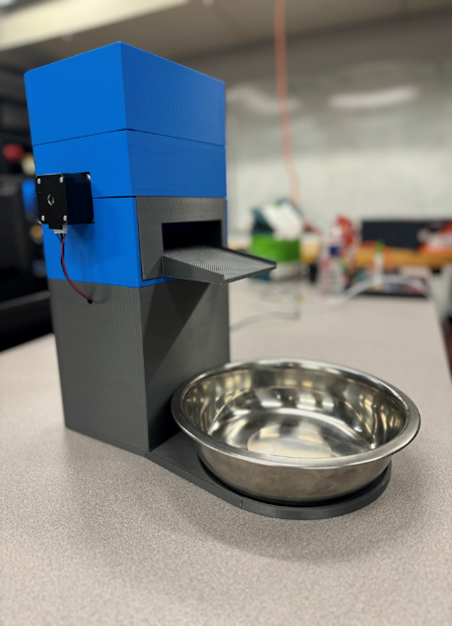
Smart IoT Pet Feeder Overview
- Wi-Fi connected feeder with app-based manual dispense and scheduled feeding.
- Motor-driven dispensing mechanism (auger/rotary) with calibrated timing for repeatable portions.
- Status logging: tracks last dispense, upcoming schedule, and user actions.
- Reliability and safety considerations: jam detection, missed-cycle handling, and manual override.
- Modular 3D-printed housing for easy cleaning and fast iteration on mechanical parts.
- Cloud/API-ready design: supports lightweight MQTT/HTTP integration hooks for smart home workflows.
Tools Used
- Embedded / IoT: Wi-Fi microcontroller (ESP32-class), motor driver, sensors (optional for jam/level), power regulation
- Firmware: C/C++ (event/state logic, scheduling, device control), OTA update support (optional)
- Networking: HTTP and/or MQTT messaging, local network control
- Mechanical: 3D-printed parts (hopper, dispenser housing, mounts), iterative prototyping
- CAD / Prototyping: CAD modeling + 3D printing workflow
Purpose
Design and build a reliable, app-connected feeder that automates daily feeding while emphasizing repeatable portioning, safe operation, and a mechanically serviceable 3D-printed design.
Results
- Implemented remote manual dispense and scheduled feeding control over Wi-Fi.
- Achieved repeatable portions through dispenser timing calibration and mechanical tuning.
- Added logging and basic fault handling to improve reliability and traceability.
- Built a modular 3D-printed enclosure that simplifies cleaning and maintenance.
Conclusion
This project demonstrates end-to-end hardware–software integration: designing a 3D-printed mechanism, building embedded firmware to control a motor-driven dispenser, and enabling reliable scheduling and remote operation over Wi-Fi. It strengthened my skills in embedded control, IoT communication, mechanical iteration, and building systems that behave predictably in real-world use. I’m continuing to refine the design through improved calibration, reliability testing, and expanded fault detection.

 garciamatthew176@gmail.com